Prints and New Film
It’s been a while since I’ve updated my news, just been too busy making and doing! I am nearly at the final stages of a residency at Rothampsted Research North Wyke, Devon, exploring the impact of UK farming upon climate change and biodiversity. It is part of a UKRI funded research project called LUNZ (Land Use for Net Zero). During my first visit to Rothamsted, I ran a workshop with a group of scientists, and installed some prints onsite.
Rothamsted is the world’s most instrumented ‘farm platform’. It is part farm (arable and livestock), part science living laboratory, and part data collection. I was surprised and delighted to find that the team is very international, which was unexpected in a rural setting near Dartmoor. The work at Rothamsted Research broadly consists of testing, experimenting and measuring the impact of different farming practices upon climate change, biodiversity soil health, emissions to water and air and food production. Ultimately, their research feeds into developing farming policies within the wider economic, political, environmental and social contexts of the UK. Important work given the impact of farming on the environment.
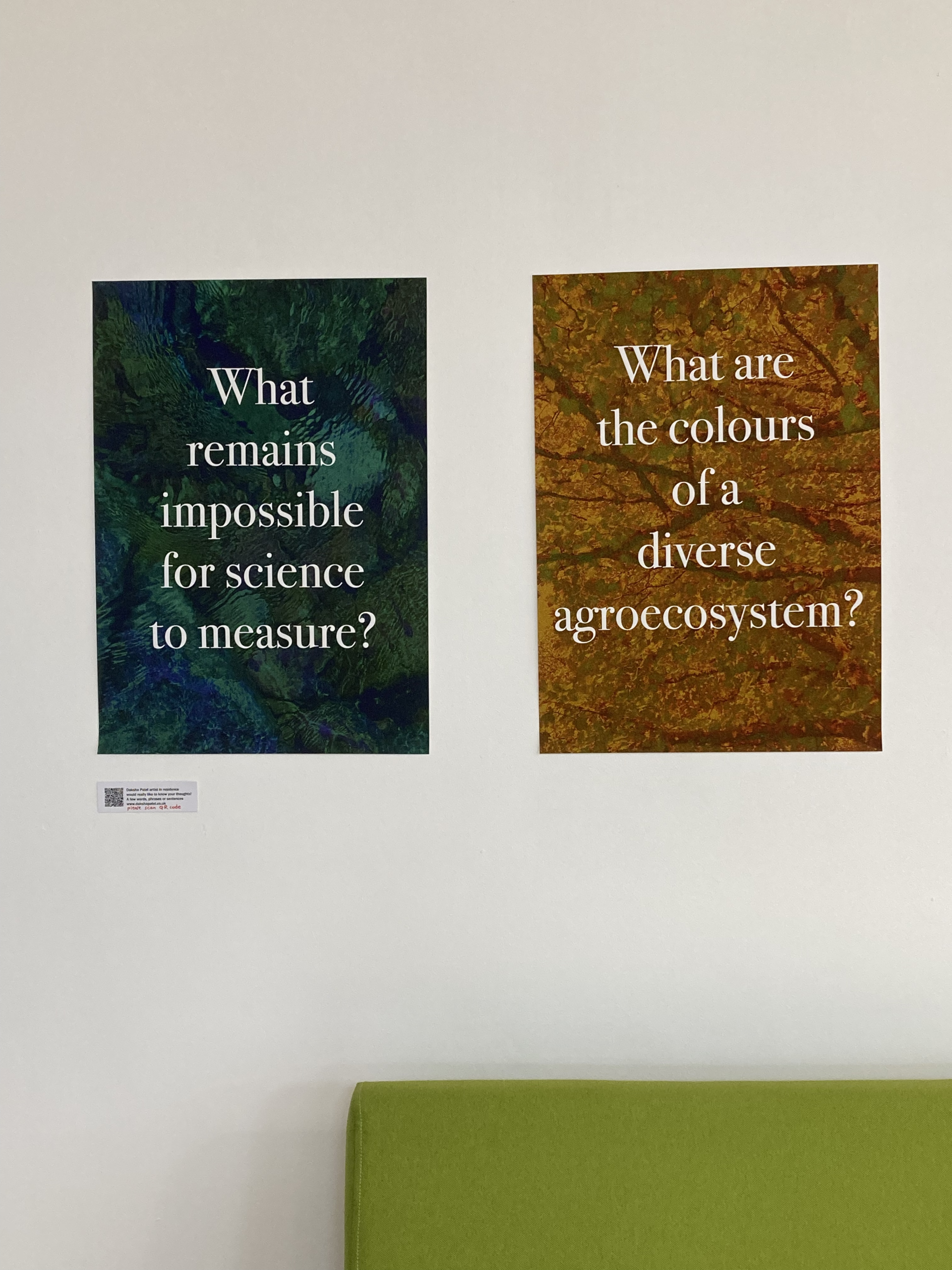
The scientists at Rothamsted Research North Wyke are working on a variety of different research questions – often really complex multi-layered questions with no easy answers. The notion of questioning became the catalyst for the creation of my first artworks – a series of ten digital prints. The use of text in conceptual art is often associated with social and political commentary, and this format seemed appropriate for this work. The questions were deliberated over time, and I think of the artworks as ‘print provocations’ because they are a stimulus for discussions and not questions that can easily be answered. They are open questions which are interrelated – they probe and inquire without fixed parameters and they enquire about the senses as well as the brain. The prints merge text with images of Rothamsted that have been edited to create a highly pixellated and colourful data visualisation aesthetic to refer to data collection and modelling processes.